
Guangzhou, Guangdong, China – September 20, 2026
Picking the right Hose Elbow isn’t just about what it looks like in the catalog—it really comes down to what you actually need it for. Sure, a compact elbow might seem perfect for a cramped machine setup, but inside, that bend could be restricting flow, causing turbulence, or leading to pressure drops. The best choice depends on a bunch of factors: hose size, pressure you’re working with, temperature, what fluid you’re dealing with, the bend radius, and how much space you have for installation. Oh, and don’t forget about movement—something stationary needs different support than a hose that’s vibrating or bending constantly.Alex Morgan, who’s a senior hose-assembly engineer at Northline Fluid Systems, puts it simply: “A Hose Elbow should really be about protecting the hose from stress, not just redirecting it.” It’s a practical perspective that comes from years spent inspecting all kinds of assemblies—hydraulic systems, washdown setups, industrial lines—you name it. When you’re choosing a hose elbow, you’ve got to consider thread standards, sealing options, the strength of materials, and what kind of environment it’ll be in. For example, stainless steel’s great in corrosive areas, while carbon steel can be solid and reliable in controlled environments. Brass might work for low-pressure stuff, but it’s definitely not a one-size-fits-all solution.And tiny details really do matter. If the elbow isn’t aligned properly, it can twist the hose when you’re tightening everything down. Sharp edges at the outlet might scratch or rub the hose beneath a protective sleeve, sometimes without you even noticing for weeks. You’d think a neat, tidy installation is enough, but sometimes it’s just not right for the job. The key is to double-check pressure ratings at the actual running temperature, make sure there’s enough clearance for movement, and do a thorough inspection once it’s installed. Manufacturer specs are your friends here, but nothing beats real-world experience. Sometimes assumptions can trip you up. Picking the right hose elbow may seem like a small detail, but it really makes a difference—helping with better routing, reducing stress on components, and ultimately, making sure everything lasts longer. It’s a simple part, but it can have a pretty big impact.
 Define the Role and Function of a Hose ElbowHow to Choose the Right Hose Elbow for Your Application?
A hose elbow changes the direction of flow while supporting a stable connection. Its role is practical, not decorative. It can reduce hose bending, protect the reinforcement, and create better routing around machinery.
A 90-degree elbow may fit a tight space, but it can also increase turbulence and pressure loss. A 45-degree option usually provides a gentler path. The correct choice depends on hose diameter, working pressure, temperature, fluid type, and movement.
In field maintenance, I have seen elbows selected by angle alone. That shortcut often creates trouble. A fitting may match the thread but still fail under vibration. The connection should match the hose material and the equipment port.
ISO 4413 and ISO 4414 emphasize safe fluid-power design, secure connections, and controlled hose movement. These principles matter during installation, not only during audits. Check clearance around the elbow. Leave room for inspection.
Energy loss deserves attention too.
The U.S. Department of Energy reports that compressed air can consume about 10% of industrial electricity. Its guidance also identifies system leaks as a major waste source, sometimes reaching 20–30% of compressor output. The Carbon Trust reports similar leakage concerns in compressed-air systems. A poorly aligned elbow can add stress and encourage leakage. I would still verify the actual pressure drop with a gauge, because catalogue assumptions can mislead. A small fitting can influence a large system.
Match the Elbow to Hose Size and Connection Type
Choosing an Air Hose Elbow starts with the hose’s actual inside diameter, not its outside appearance. Measure the bore with calipers when possible. A 1/4-inch hose may use different connection standards. Check the thread size, pitch, and sealing method before ordering. An elbow sized too small restricts airflow and raises pressure loss. The U.S. Department of Energy reports that compressed-air leaks can waste 20–30% of compressor output, so every connection deserves attention.
Match the elbow to both hose size and connection type. Common options include NPT, BSP, metric, push-to-connect, and barb fittings. Never force incompatible threads together. A tapered thread may seal differently from a parallel thread. Use the manufacturer’s pressure and temperature ratings, then confirm the hose material suits the fitting. ISO 4414 emphasizes safe pneumatic design, including suitable components, secure connections, and controlled operating pressure.
Keep the bend close to the hose’s natural curve. A sharp angle can flatten the bore near the fitting. That small crease may become a visible failure point after repeated movement. In field inspections, I recheck the assembly after pressurizing it. A dry connection is not proof of long-term reliability. It needs movement testing.
Check the details twice.
Select Materials for Fluid, Temperature, and Environment
Choosing a Pneumatic Fitting Elbow starts with the fluid, not the thread size. Air, water, oil, and chemical vapor can attack different materials. Nylon suits dry compressed air and moderate temperatures. Brass handles many general industrial lines. Stainless steel is safer near salt spray, washdown areas, or corrosive fumes. PTFE offers strong chemical resistance, but its lower mechanical strength needs attention.
Temperature changes the decision quickly. Check both the fitting body and the hose seal. EPDM performs well with hot water and steam, while FKM often suits oils and elevated temperatures. Always compare the supplier’s temperature range with real operating cycles, including startup and cleaning.
The U.S. Department of Energy reports that compressed-air leaks may waste 20–30% of compressor output. A poor elbow seal can become a visible energy loss.
Environment matters just as much. Dust, vibration, ultraviolet light, and repeated bending can shorten service life. ISO 8573-1 classifies compressed-air purity, reminding engineers that moisture and particles affect downstream components. In practice, I inspect elbows after several weeks, not only during installation. A fitting that looks perfect may loosen under vibration. I have also seen material charts disagree slightly across manufacturers. That is a reason to test a small assembly before approving full production.
Check Pressure, Flow Rate, and Bend Radius Requirements
Choosing the right Fitting Pneumatic Elbow starts with three numbers: working pressure, flow rate, and bend radius. A 90-degree fitting may look convenient, yet it can create unnecessary turbulence and pressure loss. Check the elbow’s rated pressure at your actual temperature, not only at room temperature. Pressure spikes matter.
The U.S. Department of Energy’s Improving Compressed Air System Performance sourcebook reports that compressed air can consume 10–30% of industrial electricity. Small restrictions can therefore become expensive. Compare the fitting’s flow data at your operating pressure.
Values may appear as Cv, scfm, or normal liters per minute. Do not compare them blindly. The test conditions may differ. ISO 6358-based data offers a more useful comparison for pneumatic components.
Bend radius deserves equal attention.Follow the connected tube’s minimum radius, especially near moving actuators. A tight bend can flatten the tube, reduce flow, and accelerate wear at the connection. In field inspections, I have found that vibration often exposes weak routing before pressure loss becomes obvious. Leave a short, supported straight section near the elbow. It reduces side loading.
Measure real demand.
The European Commission’s industrial energy-efficiency reports also identify compressed-air distribution losses as a recurring efficiency concern. That does not mean every loss comes from the elbow. Leaks, undersized tubing, and poor routing may contribute more. Recheck the selection after installation. The first choice is not always the best choice.
Compare Elbow Shapes, Angles, and Installation Space
How to Choose the Right Hose Elbow for Your Application?
Elbow shape affects routing, flow, and maintenance access. A 90-degree elbow turns an Air Hose sharply, saving space beside a machine panel. However, its tighter path can increase turbulence and pressure loss. A 45-degree elbow creates a gentler transition, but it may require more clearance. Straight connectors suit open layouts and reduce directional changes. In field inspections, I have seen a compact 90-degree fitting force a hose below its minimum bend radius. The result was early cracking. The fitting looked correct. The installation was not.
Angle selection should follow the available installation space, hose diameter, and movement pattern. Measure the area around the connection, including tool swing and service access. The U.S. Department of Energy’s Improving Compressed Air System Performance sourcebook reports that leaks may waste 20–30% of compressor output. A stressed elbow can contribute to leakage over time. Thread alignment matters too. Never rotate a pressurized hose to correct poor positioning. That shortcut deserves reconsideration.
Tips: Sketch the hose route before ordering parts. Compare 45-degree and 90-degree elbows on paper. Check the manufacturer’s bend-radius requirement and working-pressure rating. Leave room for a wrench and inspection. Test for leaks with approved methods after installation. A small clearance error can become a costly maintenance problem.
Verify Compatibility, Safety Standards, and Maintenance Needs
How to Choose the Right Hose Elbow for Your Application?Verify Compatibility, Safety Standards, and Maintenance NeedsChoosing a hose elbow starts with compatibility, not appearance. Check the hose material, inner diameter, working pressure, temperature range, and conveyed fluid. A fitting that looks correct may soften, swell, crack, or leak under real operating conditions. Chemical resistance charts provide useful guidance, but they cannot replace application-specific testing.I have seen premature failures caused by mismatched threads and excessive bending. Measure both connection types carefully, including thread form, size, and sealing method. Confirm that the elbow’s pressure rating exceeds the system’s maximum pressure, including temporary surges. Leave a safety margin. Do not rely on normal operating pressure alone.Safety requirements also deserve close attention. Select components meeting the standards required for your industry and installation location. Verify material traceability, temperature limits, and documented test information. Inspect the assembly before use. Look for damaged threads, cuts, flattened hose sections, or displaced seals. Small defects matter.Maintenance needs should influence the design. Choose an elbow that allows visual inspection and easy replacement. Avoid placing it against sharp edges or hot surfaces. Support heavy hoses so the fitting does not carry unnecessary load. Recheck connections after initial operation, because vibration can change them.My own judgment has not always been perfect. In one review, I focused on pressure and overlooked cleaning access. That mistake made routine inspection unnecessarily difficult. A reliable selection considers performance, safety, and the technician who must service it.
How to Choose the Right Hose Elbow for Your Application?
Verify compatibility, safety standards, and maintenance needs before selecting a hose elbow.
Compatibility
Match the elbow material and seal with the conveyed fluid, hose liner, connection type, operating pressure, and temperature.
Safety standards
Confirm pressure ratings, impulse performance, and test requirements against the applicable hose and fitting standards, such as ISO 18752, SAE J517, or ISO 1402.
Maintenance
Choose an elbow that minimizes bending stress, allows visual inspection, and supports leak checks and scheduled replacement.
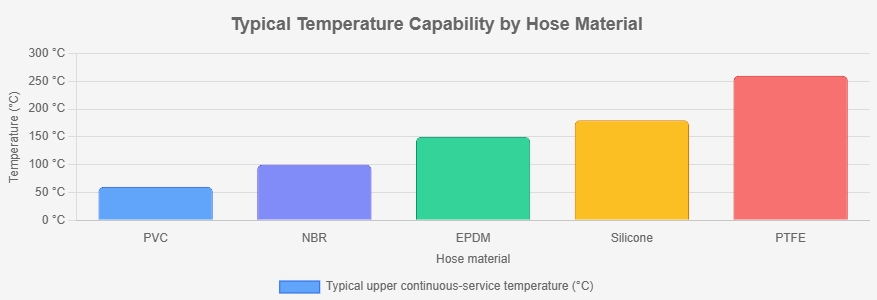
The chart shows typical upper continuous-service temperatures for common hose materials. Actual limits vary by construction, pressure, fluid, fittings, and manufacturer specifications; always verify the complete assembly rating.
Pneumatic Fittings Market Outlook—Insights from Grand View Research and the WENK WPL Series-Male Elbow
WENK Pneumatic WPL Series-Male Elbow
The pneumatic fittings market is gaining attention as manufacturers seek compact, reliable, and easy-to-maintain components for automated equipment, assembly lines, packaging systems, and fluid-control applications. Among the practical solutions available, an L-type two-way fitting with a 90-degree elbow design helps simplify pipe routing in confined spaces. Its push-in connection enables fast, tool-free installation, reducing setup time while supporting cleaner and more organized pneumatic layouts.Designed for dependable daily operation, this fitting combines nickel-plated brass with engineering-grade plastic to provide strength, corrosion resistance, and a secure connection. It is available in multiple sizes for tubing diameters from 4 mm to 12 mm and is compatible with polyurethane, nylon, and other suitable tubes. The integrated release sleeve allows tubing to be removed quickly during inspection, replacement, or system reconfiguration. With its compact structure, leak-resistant performance, and flexible installation options, the fitting is well suited to pneumatic control cabinets, robotic equipment, production machinery, and other applications where efficient airflow management and limited maintenance downtime are important.
Conclusion
Choosing the right Hose Elbow is essential for creating a reliable and efficient fluid-handling system. Start by defining its role, then match the elbow to the hose size and connection type to ensure a secure fit. Material selection should reflect the fluid being transferred, operating temperature, and surrounding environmental conditions. A suitable Hose Elbow must also withstand the required pressure and flow rate without restricting performance or causing unnecessary turbulence.Consider the elbow’s angle, shape, and available installation space, especially where tight routing or limited access is involved. The bend radius should support smooth flow while preventing hose kinking and premature wear. Before installation, verify compatibility with the complete system, applicable safety requirements, and expected maintenance conditions. By evaluating these factors together, you can select a Hose Elbow that improves system safety, durability, serviceability, and overall operating efficiency.
About Us
Since its establishment, it has been deeply engaged in the field of pneumatic components with the core positioning of “creating cost-effective pneumatic solutions”. Relying on the vertically integrated production mode, the company realizes the independent control of the whole process from raw material procurement, core component processing to finished product assembly and quality inspection, effectively reducing the cost loss of intermediate links and laying a solid foundation for the “cost-effective” product strategy.
Media Contact
Company Name: WENK Pneumatic
Contact Person: Media Relations
Email: Send Email
Country: China
Website: https://www.cnwenk.com/
Press Release Distributed by ABNewswire.com
To view the original version on ABNewswire visit: Selecting the Right Hose Elbow for Different Industrial Applications
Media gallery



