Toyota Hydrogen Solutions Achieves Key Certifications for Commercial Fuel Cell Units
PR Newswire
GARDENA, Calif. and PLANO, Texas, April 29, 2026
Certifications conform to important safety and compliance milestones that support the commercial scaling of stationary power generators in North America
GARDENA, Calif. and PLANO, Texas, April 29, 2026 /PRNewswire/ — Toyota Hydrogen Solutions today announced that its fuel cells have earned ANSI/CSA FC 1 and ANSI/CSA FC 6 certification, bringing them one step closer to wider adoption for stationary power generator applications.
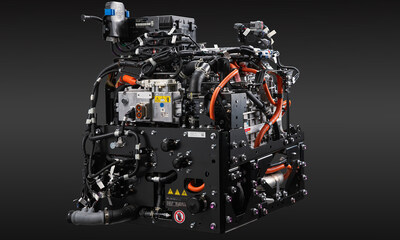
These certifications are important milestones that validate the specific safety and compliance standards set forth by the American National Standards Institute (ANSI) and CSA Group, a worldwide standards organization based in Canada.
Hydrogen fuel cells offer a solution that’s more eco-conscious than traditional internal combustion power generators. They can ease overburdened electricity grids and augment critical infrastructure like hospitals.
“With our stationary Toyota fuel cell earning ANSI/CSA FC 1 and FC 6 certifications, there’s now a significantly lower barrier to adoption,” said Thibaut de Barros Conti, vice president, Toyota Hydrogen Solutions. “These rigorous certifications should put customers at ease when it comes time for their businesses to make investments into more environmentally conscious power generation.”
Toyota has been developing fuel cells for decades and more recently began expanding applications to stationary power generation, commercial trucking and port equipment, among other use cases. Fuel cells work by combining gaseous hydrogen and oxygen across an electrochemical process to produce electricity, resulting in only water vapor as its exhaust.
Stationary fuel cell power generators are often allowed to operate with fewer restrictions than traditional internal combustion generators, given they create no carbon emissions at the point of use and reduced sound emissions. As fuel cells are often allowed to operate without interruption so long as there’s a fuel source, they can serve as a resource to aid in peak shaving – helping augment the electrical grid and lower strain – or even serve as a remote power source in areas not connected to a grid, such as disaster response sites or remote facilities.
Last year at the Advanced Clean Transportation (ACT) Expo, Toyota announced its collaboration with Rehlko (formerly Kohler Energy), a global leader in energy resilience, to supply Toyota fuel cells to power 1 MW generators. From consultation to system development and integration, Toyota Hydrogen Solutions is positioned to offer a proven and capable fuel cell, and a disciplined approach to safety and quality, providing solutions for organizations looking to reduce carbon emissions.
For customer inquiries, please visit Toyota Hydrogen Solutions | Toyota.com.
Toyota Hydrogen Solutions will have a stationary power generator, among a number of other assets, on display at ACT Expo 2026, which runs May 4-7 at the Las Vegas Convention Center, booth #2767. For more information, visit Advanced Clean Transportation (ACT) Expo.
About Toyota Hydrogen Headquarters (H2HQ)
Toyota Hydrogen Headquarters (H2HQ) is the lead office in North America for the development, engineering, commercialization and business operations of Toyota’s hydrogen fuel cell technologies. Based in Gardena, California, H2HQ works collaboratively with Toyota’s R&D offices in Michigan and Texas, as well as business units in Japan and internationally, to create zero-emissions fuel cell technologies that enable energy independence, innovation and the movement of people, goods, energy and information.
For more information about Toyota, visit Toyota Hydrogen Headquarters (H2HQ) – Toyota USA Newsroom.
About Toyota
Toyota (NYSE:TM) has been a part of the cultural fabric in North America for nearly 70 years, and is committed to advancing sustainable, next-generation mobility through our Toyota and Lexus brands, plus our more than 1,800 dealerships.
Toyota directly employs nearly 64,000 people in North America who have contributed to the design, engineering, and assembly of nearly 49 million cars and trucks at our 14 manufacturing plants. In 2025, Toyota’s plant in North Carolina began to assemble automotive batteries for electrified vehicles.
For more information about Toyota, visit www.ToyotaNewsroom.com.
Media Contact
Jacob Brown
Jacob.brown@toyota.com
469-486-4042

 View original content to download multimedia:https://www.prnewswire.com/news-releases/toyota-hydrogen-solutions-achieves-key-certifications-for-commercial-fuel-cell-units-302756678.html
SOURCE Toyota Motor North America


